
Home / Commodities / Coffee
Export commodity
Washed, natural and honey-process Arabica from Gayo and Mandheling, highland Arabica from Toraja, and Robusta grades. Cupped, graded, and export-baled at origin.
HS 0901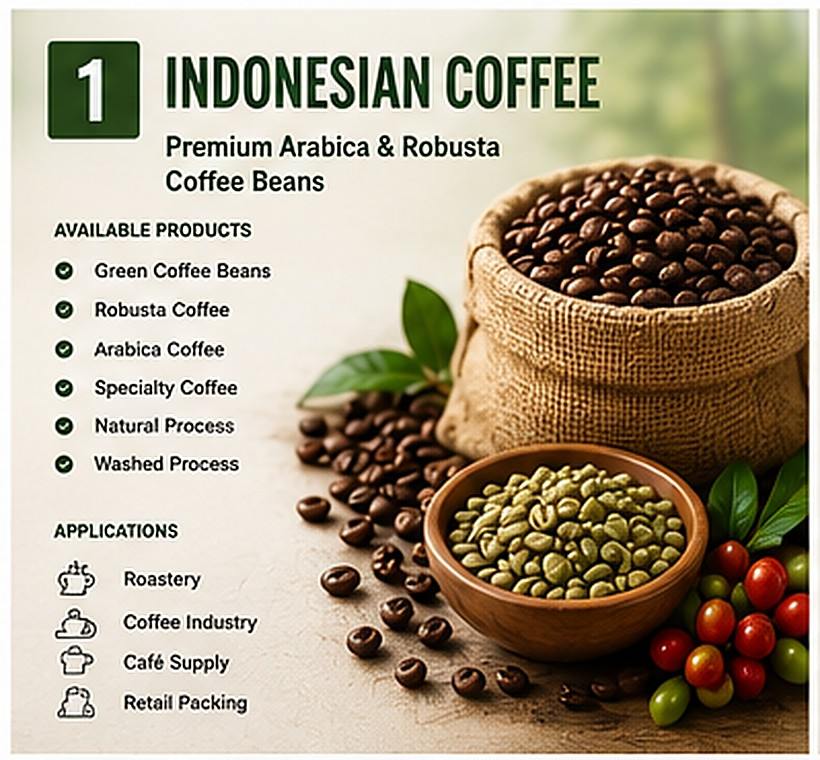
Overview
Indonesia is the fourth largest coffee producer in the world, and its value to importers comes from variety rather than volume alone. A single origin list can cover the bright, citrus-forward washed Arabica of the Gayo highlands, the heavy-bodied earthiness of wet-hulled Mandheling, the clean syrupy cup of Toraja, and the neutral, high-yield Robusta that blenders and instant manufacturers depend on. We buy directly from collecting cooperatives at harvest, then dry-mill, screen, and hand-sort to the grade our buyer contracted for. Every lot leaves with its moisture, defect count, and screen distribution documented so your quality team can check the container against the contract, not against a promise.
Grades
Cupping 80+ with a defect count under 11 per 300g. Traceable to a single cooperative, supplied with a cupping score sheet.
Blend-ready Arabica with a wider defect tolerance, priced for roasters filling volume blends.
Dry-processed Robusta, screen 16 and above, low defect. The standard base for espresso blends and instant extraction.
Where it's grown
Post-harvest
Cherries are pulped and fermented at village level, then delivered to our dry mill as parchment or asalan. From there the lot is rest-dried to contract moisture, hulled, density-separated, screened, and passed across a hand-sorting table where remaining defects are picked out. Wet-hulled Mandheling follows the Giling Basah route that gives the cup its signature body. Lots are then rested in GrainPro or jute before bagging, so moisture does not migrate in the container.
Season
Main harvest runs May to September in Sumatra and Aceh, with Java and Sulawesi peaking June to October. Robusta concentrates in the May to August window. Shipping plans made three to four months ahead of your production schedule get the best selection and price.
Who buys it
Single-origin lots with cupping notes and traceability back to the collecting cooperative.
Consistent Robusta and mid-grade Arabica for blends, filter packs, and instant coffee.
Custom blend ratios and bag sizes for retail and foodservice brands.
Packing, shipping & documents
Standard packing is 60kg jute bags, with GrainPro or hermetic liners recommended for Arabica crossing the equator or heading into long storage. Big bags of 500kg to 1,000kg are available for buyers with bulk intake. A 20ft container carries roughly 18 tonnes and a 40ft about 19.2 tonnes depending on packing. Every shipment travels with a certificate of origin, phytosanitary certificate, ICO certificate of origin where required, weight and quality certificate, and packing list. Pre-shipment samples of 300g to 1kg are sent by courier before the container is booked.
Questions buyers ask
Arabica from specialty Grade 1 through commercial Grade 3 to 4, and Robusta from Grade 1 to Grade 4 including EK1. Every lot is cupped and screened against your written specification before loading.
Yes. Gayo, Mandheling and Toraja lots trace back to the collecting cooperative, and we supply cupping scores plus lab moisture and defect reports with each shipment.
60kg jute as standard, GrainPro or hermetic liners on request, and 500kg to 1,000kg big bags for bulk buyers. Vacuum-packed samples ship before you commit to a container.
Sumatra and Aceh peak May to September, Java and Sulawesi June to October, and Robusta concentrates May to August. Contracting three to four months ahead secures the best lots.
One full container is standard, roughly 18 tonnes in a 20ft. Smaller trial lots can be consolidated with other commodities from our range to reach a shippable volume.
Let's talk tonnage
Tell us your grade, volume, and destination port. We reply within one business day with an offer, samples, and lead time.
Other commodities